




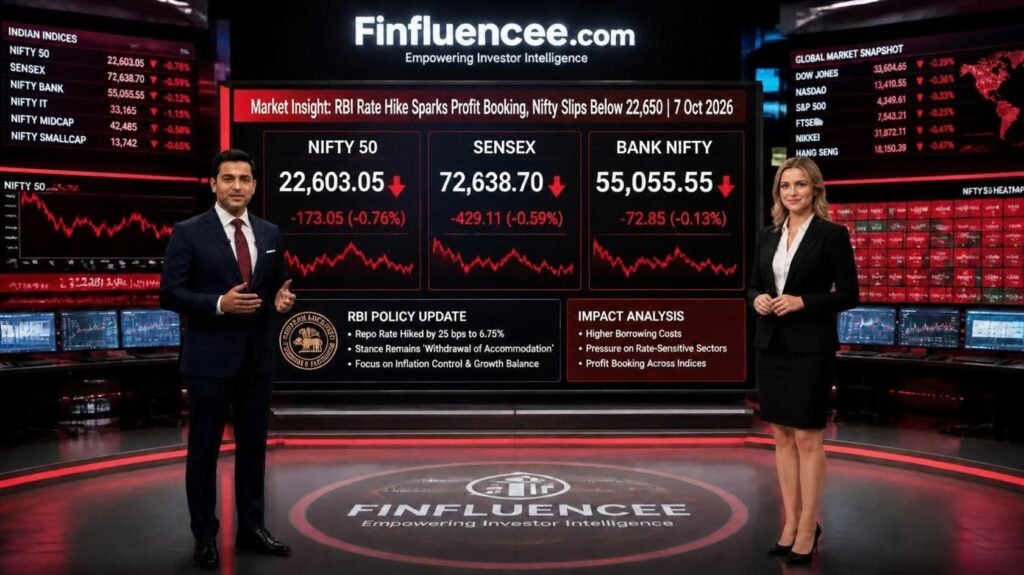
Indian equities closed sharply lower on Wednesday after the Reserve Bank of India delivered a 25-basis-point repo rate hike and shifted its policy stance toward calibrated tightening, triggering broad-based profit booking across rate-sensitive sectors. The move surprised a section of the market that was expecting policy continuity amid recent moderation in commodity prices.
Markets opened weak and remained under pressure throughout the session as investors reassessed growth, liquidity, and borrowing-cost expectations. The initial decline deepened after the RBI announcement, with metal, auto, realty, and power stocks witnessing aggressive selling. Despite the weakness in benchmark indices, banking stocks showed relative resilience, helping prevent a steeper correction.
The policy decision came against a backdrop of elevated global uncertainty. While the RBI upgraded its growth assessment, investors focused more on the implications of tighter monetary conditions and the possibility of higher funding costs over the coming quarters. Higher interest rates generally weigh on consumption and corporate borrowing, leading traders to adopt a cautious stance.
Sector rotation was clearly visible throughout the trading session. PSU Banks and Telecom attracted buying interest, while Metals emerged as the biggest casualty. Realty and Auto stocks also faced heavy selling as higher interest rates could potentially impact future demand trends.
Market breadth weakened considerably. Declining stocks significantly outnumbered advancing stocks, indicating that the selling pressure was broad-based rather than restricted to a handful of heavyweight stocks. Rising volatility further highlighted growing caution among traders ahead of earnings season.
Benchmarks — Closing Snapshot
| Index | Close | Change | % Change |
| Sensex | 72,638.70 | -429.11 | -0.59% |
| Nifty 50 | 22,603.05 | -173.05 | -0.76% |
| Bank Nifty | 55,055.55 | -72.85 | -0.13% |
Sector Performance
Outperformers
- PSU Bank advanced approximately 1.00% and emerged as the strongest sector.
- Media gained around 0.69%.
- Telecom rose approximately 0.55%.
- Capital Markets added nearly 0.49%.
- Kotak Mahindra Bank and Bharti Airtel featured among the session’s notable gainers.
Underperformers
- Metal declined approximately 2.33%, emerging as the worst-performing sector.
- Realty slipped around 1.77%.
- Auto lost approximately 1.58%.
- Power fell nearly 1.40%.
- Titan, Adani Enterprises and Hindalco remained among the biggest losers.
Institutional Flow
FIIs: Data for 7 October 2026 was not available in the retrieved market-close reports at publication time.
DIIs: Data for 7 October 2026 was not available in the retrieved market-close reports at publication time.
Insight: Regardless of the day’s correction, domestic institutional participation continues to be a critical stabilizing force for Indian equities whenever foreign flows turn volatile.
Technical Structure for Thursday (8 Oct 2026)
NIFTY 50
- Support: 22,500 – 22,450
- Major Support: 22,300
- Resistance: 22,750 – 22,850
- Major Resistance: 23,000
Trend Read: Nifty has fallen back below the 22,650 zone after the RBI announcement and now enters a short-term corrective phase. Sustaining above 22,500 remains crucial to prevent deeper weakness toward the 22,300 area.
BANK NIFTY
- Support: 54,800 – 54,500
- Major Support: 54,000
- Resistance: 55,300 – 55,600
- Major Resistance: 56,000
Trend Read: Bank Nifty displayed considerable relative strength despite the broader market sell-off. Holding above 54,800 would keep the intermediate bullish structure intact.
Options View — Cautious Bias
- Strong support is visible near the 22,500 strike.
- Resistance is shifting toward the 22,800–23,000 zone.
- India VIX rose to 13.89, indicating increasing volatility expectations.
- Traders are likely to remain cautious until the market fully digests the RBI policy action.
Insight: Derivative positioning reflects a move from optimism to caution. While panic is absent, traders may prefer selective stock opportunities rather than aggressive index exposure in the immediate term.
Strategy — How to Navigate Now
Intraday / Option Buyers
- Focus on PSU Banks and Telecom counters showing relative strength.
- Avoid aggressive long positions in Metals and Realty.
- Prefer disciplined stop-losses as volatility increases.
Swing Traders (1–3 Weeks)
- Watch whether Nifty sustains above 22,500.
- Accumulate quality banking stocks on declines.
- Remain selective rather than chasing momentum.
Long-Term Investors
- Continue staggered investments through SIPs.
- Use policy-driven volatility for gradual accumulation.
- Focus on fundamentally strong leaders with earnings visibility.
Quick Reference — Levels for Workflow (8 Oct 2026)
| Index | Buy on Dip Zone | Resistance | Risk Zone |
| Nifty 50 | 22,500–22,450 | 22,750–23,000 | Below 22,300 |
| Bank Nifty | 54,800–54,500 | 55,300–55,600 | Below 54,000 |
| Sensex | 72,300–72,000 | 73,200–73,800 | Below 71,500 |
Final Take
The RBI policy meeting became the defining event for Indian markets on 7 October. A surprise repo rate hike and a shift toward calibrated tightening triggered broad-based profit booking, ending the market’s two-session recovery. The Sensex lost more than 429 points, Nifty slipped below 22,650, and several rate-sensitive sectors witnessed meaningful pressure. However, the resilience shown by Bank Nifty and PSU Banks suggests that institutional investors are not abandoning equities but are instead rotating toward sectors that may benefit from a higher-rate environment.
Going forward, investors should watch:
- Market reaction to the RBI’s hawkish stance.
- Nifty’s ability to defend the 22,500 support zone.
- Banking sector leadership.
- Institutional flow trends after the policy announcement.
- Volatility levels and earnings-season expectations.
Disclaimer
This Market Insight is prepared for educational and informational purposes only. It does not constitute investment advice, recommendation, or solicitation to buy/sell securities. Readers are advised to consult a SEBI-registered financial adviser before making any investment or trading decisions.