



Capital Markets — The Big Picture
India’s capital market is the place where businesses and governments raise money and where investors grow wealth. It runs on two tracks: the primary market (new issues) and the secondary market (daily trading after listing). The ecosystem operates under SEBI’s oversight, and investor holdings are kept electronically in Demat accounts at NSDL/CDSL via a Depository Participant (DP).
Primary vs Secondary:
Primary market: A company (or a REIT/InvIT sponsor trust) raises money by selling new shares/units via IPOs/FPOs or promoter/government stake sales through OFS. If allotted, the securities are credited straight to your Demat. After listing, the same security trades daily on the exchange.
Secondary market: The everyday marketplace (NSE/BSE) where buyers and sellers trade already‑listed securities, enabling price discovery and liquidity. For most retail investors, long‑term wealth building primarily happens here through disciplined participation SIPs and staggered buys.
What you can invest:
Equity
(individual shares, equity mutual funds, index funds/ETFs): the main growth engine for long‑term portfolios. For beginners, a Nifty 50 index fund is a simple Core holding. If you prefer ETFs, you get intraday trading but must watch liquidity and bid‑ask spreads.
Debt
(bonds, debt mutual funds): the stability bucket—helps you meet near‑term goals and dampen equity volatility. Held/settled in Demat using the same custody rails.
REITs/InvITs
Regulated vehicles that hold commercial real estate (REITs) or infrastructure assets (InvITs). Often used for income diversification; always review the tax character of payouts before investing.
Sovereign Gold Bonds (SGBs)
Government‑backed gold exposure that pays annual interest and sits neatly in your Demat; appears in your periodic CAS like other holdings.

Who ensures safety and how records are kept (Demat, NSDL/CDSL, CAS)
Your securities do not exist as paper certificates. They are held electronically in a Demat account with NSDL or CDSL through your DP (broker/bank). The depositories handle electronic transfer/settlement, process corporate actions (dividends, splits, bonuses), enable pledging/nomination, and issue your CAS (monthly if you had transactions; otherwise, half‑yearly). This setup keeps markets efficient, fast, and far safer than the pre‑Demat era.
The regulator and the marketplace (SEBI, Exchanges)
SEBI sets the rulebook to keep markets transparent, fair, and investor‑friendly (listing norms, disclosures, intermediaries, grievance redress).
Stock exchanges (NSE/BSE) are auction platforms where orders match and surveillance runs. When you place an order in your app, it routes to an exchange; on execution, settlement entries flow to your Demat via the depository.
Why costs show up on your contract note (and what STT is)
Every transaction carries a transparent bill: brokerage, exchange/clearing fees, GST, stamp duty, and STT (Securities Transaction Tax). STT is a transaction‑value levy on eligible trades applicable regardless of profit/loss which is why it appears even on a losing trade. Your broker collects and remits it automatically.
The plumbing that keeps you safe (Demat, CAS, costs)
1) Demat = your safe, digital vault
Your shares, bonds, REIT/InvIT units, SGBs, and MF units live electronically in a Demat account with NSDL or CDSL, accessed via your DP. Depositories handle transfers/settlement, corporate actions, pledging/unpledging, and nomination so credits/debits happen cleanly and quickly after a trade.
2) CAS (Consolidated Account Statement) = your official audit trail
You receive a CAS from the depository system monthly if there were transactions, otherwise half‑yearly—showing all holdings and movements. Keep your email/mobile updated with your DP to ensure you get CAS and instant debit/credit alerts.
3) Service timelines exist and they’re defined
Dematerialisation/rematerialisation, transmission, pledges, account closure, and settlement instruction cut‑offs run on published timelines in DP/depository charters. If you need to chase a request, cite these timelines with your DP.
4) Know your entire cost (don’t just look at brokerage)
Every executed order shows these lines on your contract note:
- Brokerage: Your broker’s fee; percent or flat per order.
- Exchange & Clearing Fees: Charged by exchanges/clearing corporations for trade processing.
- STT (Securities Transaction Tax): Transaction‑value tax on eligible trades applies even on a losing trade. Broker auto‑collects and remits it.
- GST: Charged on brokerage and certain fees at prevailing rates.
- Stamp Duty: State‑notified duty on the contract value, auto‑collected.

A realistic starter plan:
Open your rails (Demat + Trading) and turn on alerts
- Open a Demat + trading account with a DP/broker you trust.
- Enable e‑CAS emails and real‑time NSDL/CDSL SMS/email alerts so every credit/debit pings you.
- Save your DP’s support email and your depository ID in Notes for quick service requests.
Start a simple, low‑cost Core (Nifty 50 SIP)
- Set up a monthly SIP in a Nifty 50 index fund (Direct plan, low expense ratio, low tracking error).
- After 6–12 months, add a Nifty Next 50 index fund for breadth (small allocation at first).
- If you prefer intraday flexibility, use an ETF but place limit orders and check liquidity/spreads.
Ring‑fence your shock absorber (3–6 months of expenses)
- Keep 1–2 months in a high‑interest savings/sweep‑in FD for instant access.
- Park the rest in a liquid fund so money stays accessible but earns a little more.
- Label the account ‘Emergency Do Not Touch.’
Know your bill (so costs don’t quietly erode returns)
- Review one contract note and identify brokerage, exchange/clearing, STT, GST, stamp duty.
- Create a tiny sheet to track charges for a month; choose cost‑efficient products/order types.
Expand steadily once the base is set (income & diversification)
- Consider REITs/InvITs for rental‑style or infrastructure cash‑flow exposure after your core SIP and emergency fund.
- Read the taxation section of the factsheet first (distribution components may be taxed differently).
- Start small, check cash‑flows vs expectations, then size up.
FAQs
Q1) Do I need both Demat and Trading accounts?
Yes. Trading sends your orders to the exchange; Demat is the digital locker that holds your shares/units at NSDL/CDSL via your DP. Most brokers bundle both.
Q2) Is my money safe in Demat?
Your securities are recorded electronically in your name at NSDL/CDSL. Turn on depository alerts and review your CAS monthly if there were transactions, otherwise half‑yearly.
Q3) Why do I see STT even on a losing trade?
STT is charged on the transaction value, not on profit. It’s auto‑collected on eligible trades and remitted by your broker to the government.
Q4) Where do REITs/InvITs fit in my plan?
Add them after a core index SIP and a proper emergency fund. They can provide income diversification, but read distribution/tax notes and understand underlying risks.
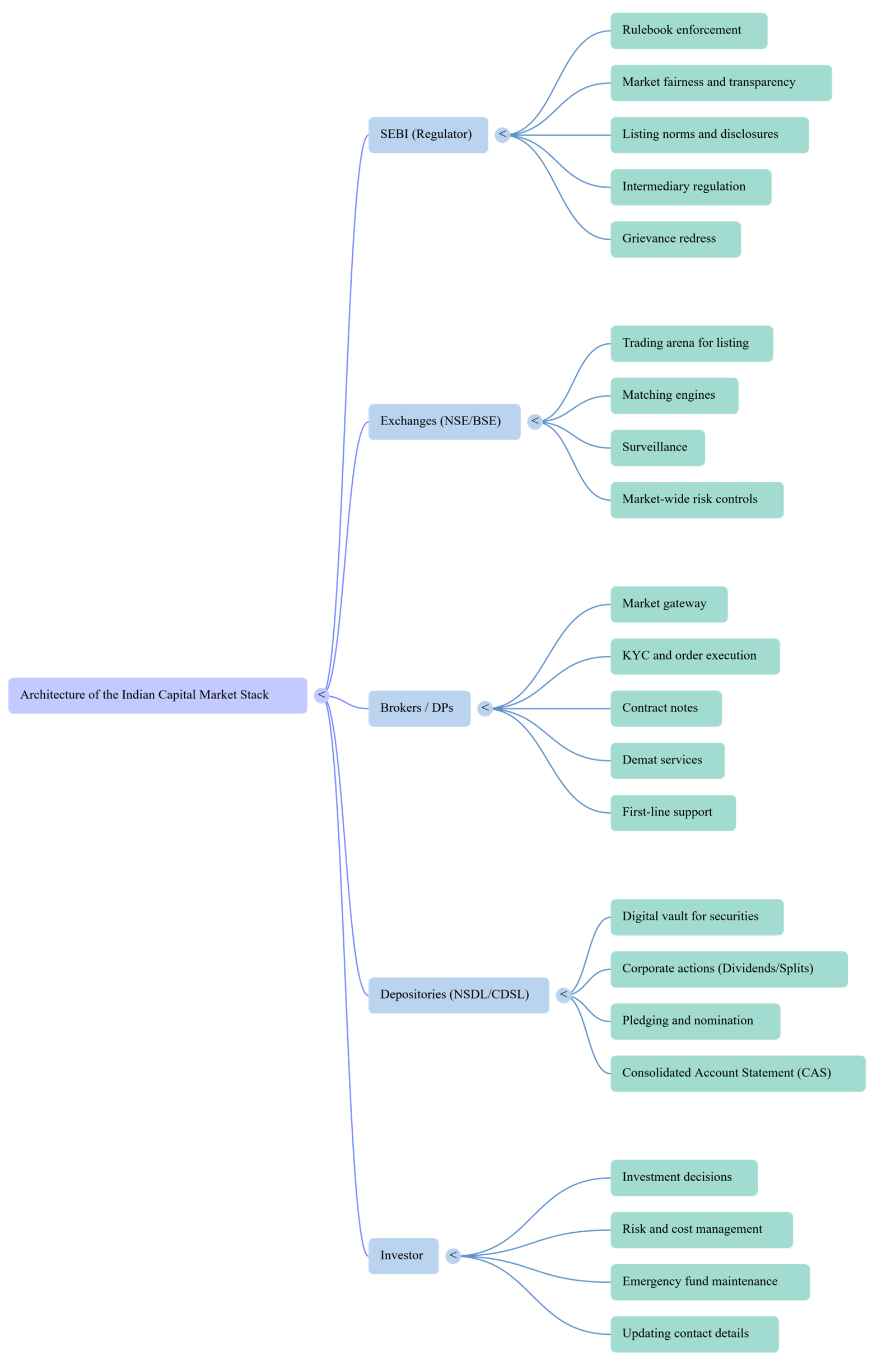
Who does what (India’s capital market stack)
SEBI (Regulator): Writes and enforces the rulebook; keeps markets fair, transparent, and investor‑friendly (listing norms, disclosures, intermediaries, grievance redress).
Exchanges (NSE/BSE): Provide the trading arena for listing and daily buy/sell; run matching engines, surveillance, and market‑wide risk controls.
Brokers / DPs: Your gateway KYC, order execution, contract notes, and all Demat services (as your DP), plus first‑line support.
Depositories (NSDL/CDSL): Hold securities in Demat, process corporate actions, support pledging/unpledging and nomination, and issue the CAS.
You (Investor): Choose products, manage risk/costs, keep an emergency fund, and keep your DP contact details updated so alerts and CAS reach you on time.
Costs checklist
Every trade/transaction carries these typical items. Exact numbers vary by product and broker always review your contract note.
| Charge | What it means |
| Brokerage | Your broker’s fee; percent or flat per order. |
| Exchange & Clearing Fees | Charged by exchanges/clearing corporations for trade processing. |
| STT (Securities Transaction Tax) | Government levy on eligible trades based on transaction value (applies even when the trade is loss‑making). |
| GST | Applied on brokerage and certain fees (as per prevailing rates). |
| Stamp Duty | State‑notified duty on contract value, auto‑collected. |
Disclaimer:
This article is for education only and is not investment, tax, or insurance advice. Markets involve risk. Do your own research and/or consult a SEBI‑registered investment advisor before acting. Past performance does not guarantee future results.